

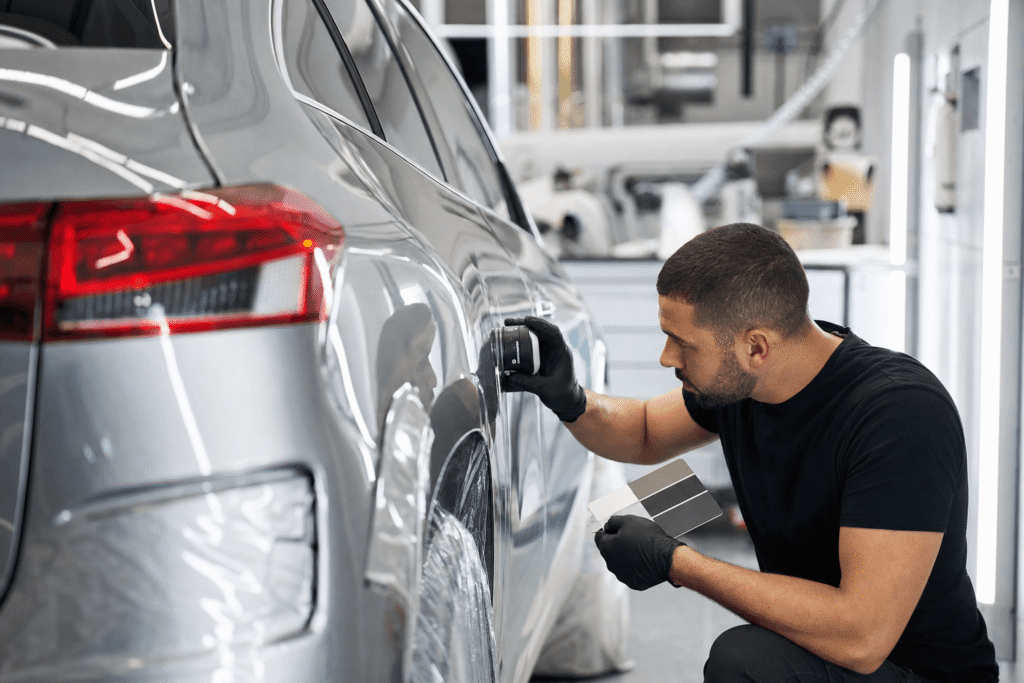
When you need collision repair services or professional paint touch-up services, one question matters most: can the shop match your car’s exact color? Auto body shops use a combination of technology, technique, and experience to match paint. The process involves locating your vehicle’s original paint code, using spectrophotometers to analyze color variations, adjusting formulas to account for fading and weathering, then applying precise blending techniques to create seamless repairs.
North Vancouver’s coastal environment creates unique challenges. BC’s heavy rain exposure, UV damage from summer sun, and salt air all contribute to paint oxidation and color shift over time. At TDB Auto, we see these effects daily on vehicles throughout the Lower Mainland.
Quick Answer
Auto body shops match paint by locating your vehicle’s OEM paint code, using spectrophotometers to analyze the current color accounting for fading, adjusting the formula to match weathered paint rather than factory specs, then blending the repair across multiple panels for seamless results.
How Auto Body Shops Match Paint: The Complete Process
Paint matching isn’t a single step. It’s a multi-stage process that combines technology with hands-on technique. Each stage addresses a different challenge in recreating your vehicle’s exact appearance.
Most people think shops just look up a paint code and spray. That approach fails almost every time. Factory paint codes give you a starting point, but they don’t account for how your specific vehicle’s paint has aged since it left the factory.
Step 1: Locating Your Vehicle’s OEM Paint Code
Every vehicle has a manufacturer paint code stamped somewhere on the body. Common locations include the driver’s door jamb, under the hood near the firewall, inside the glove box, or in the trunk. These codes identify the original factory color formula.
For a 2018 Mercedes C-Class in Iridium Silver, the code might read “775”. For a BMW in Alpine White, it’s “300”. These codes reference specific paint formulas in manufacturer databases that shops access through their paint suppliers.
Step 2: Spectrophotometer Analysis and Formula Adjustment
Modern paint matching relies on spectrophotometers. These handheld devices measure light reflection across dozens of wavelengths to create a precise color fingerprint of your vehicle’s actual current paint.
The technician places the device against an undamaged panel near the repair area. The spectrophotometer captures the color data and sends it to a computer system loaded with paint manufacturer databases. The system then recommends formula adjustments to match the scanned color rather than the original factory code.
This step accounts for fading, oxidation, and color shift. The shop receives a custom formula with specific ratios of toners, bases, and additives. This adjusted formula becomes the starting point for creating the actual paint mixture.
Key Takeaways
- Expect spectrophotometer scanning to adjust formulas beyond factory paint codes
- Understand that perfect matches are impossible due to aging and oxidation
- Verify shops use multi-panel blending for metallic and pearlescent paints
- Budget for proper surface prep which directly affects final color accuracy
- Ask technicians to spray test panels before full application begins
Paint Matching Technology: Spectrophotometers and Computer Systems
Spectrophotometers revolutionized paint matching. Before this technology, technicians mixed colors by eye using color chips and experience. Results varied wildly depending on lighting conditions and individual color perception.
Today’s spectrophotometers measure color across the visible spectrum. They capture data points that human eyes can’t distinguish. The device breaks down color into measurable components: hue, value, chroma, and undertones.
This data feeds into software systems from major paint manufacturers like PPG, BASF, or Axalta. These systems contain formulas for hundreds of thousands of automotive colors. The software compares the spectrophotometer reading to its database and calculates the closest formula match.
We always scan multiple panels on the same vehicle before mixing paint. Color can vary between the roof, doors, and bumpers due to different sun exposure. Scanning the panel adjacent to the repair gives the most accurate match.
Factory Paint Batch Variations and Technician Adjustments
Even on newer vehicles, paint batch variations from the factory create matching challenges. Manufacturers source pigments from multiple suppliers and adjust formulas between production runs. Two identical vehicles built months apart might show subtle color differences despite having the same paint code.
Technicians make specific adjustments to compensate. First, they create test spray-out panels using the base formula. They spray a small card and compare it directly against the vehicle under natural light. If the test panel appears too warm, they add cooler toners to shift the undertone. If it appears too dark, they reduce the color saturation by adding white or aluminum base.
For metallic paints, technicians adjust the metallic additive ratio. More metallic creates a brighter, lighter appearance. Less metallic produces deeper color saturation. They also adjust spray gun technique: increasing gun distance spreads metallic flakes wider for a lighter effect, while decreasing distance concentrates them for darker appearance.
For pearlescent finishes, technicians adjust pearl concentrate amounts and may layer different pearl toners to match the color-shift effect. They spray multiple test cards at different angles to verify the pearl effect matches under various lighting conditions before committing to the full repair.
Special Challenges: Matching Metallic, Pearlescent, and Multi-Layer Paints
Solid colors like basic white, black, or red present straightforward matching challenges. Metallic and pearlescent paints multiply the difficulty exponentially.
Metallic paints contain aluminum flakes suspended in the color base. These flakes reflect light differently depending on viewing angle. Matching requires getting the flake size, density, and orientation correct during application.
Pearlescent paints are even more complex. They use mica particles coated with titanium dioxide or iron oxide. These particles create color-shifting effects, where the paint appears to change hue as you move around the vehicle.
Tri-coat paints add another layer. These finishes apply a base color, then a mid-coat with metallic or pearl effects, then a clear coat on top. Each layer must be matched and applied with precise timing and thickness to recreate the original appearance.
Need a free estimate in North Vancouver?
Nima and the TDB Auto team offer honest, expert auto body repairs for all makes including European and luxury vehicles. No pressure, no unnecessary claims.
Paint Preparation, Application, and Blending Techniques
Perfect color mixing means nothing without proper surface preparation and application technique. This is where many shops cut corners, leading to poor results regardless of color accuracy.
Surface Preparation Requirements
Paint adheres chemically to the surface beneath it. Any contamination or improper sanding will cause problems even if the color matches perfectly. Proper prep starts with thorough cleaning using wax and grease remover. Next comes sanding with progressively finer grit sandpaper, typically starting at 180-320 grit for body filler areas, then finishing with 400-600 grit on surrounding paint.
Single-Panel Matching vs. Multi-Panel Blending
Single-panel matching attempts to paint only the damaged panel. This works only on very new vehicles with solid colors and small scratch repair solutions in inconspicuous areas. Even then, results are visible under certain lighting.
Multi-panel blending produces superior results. The technician applies full color coverage to the damaged panel, then extends the color in gradually thinning coats onto adjacent panels. For a door repair, the blend typically extends onto the front fender and rear quarter panel. For bumper repair and repainting, it extends onto the quarter panels or fenders.
Application Technique
Spray gun distance should stay consistent at 6-8 inches from the surface. Air pressure should match the paint manufacturer’s specifications, typically 25-30 PSI at the gun. Overlap between spray passes should be 50-75% to ensure even coverage. Most automotive paints require booth temperatures between 65-75°F and humidity below 60% for proper flow and curing.
| Repair Approach | Coverage Area | Best For | Visibility Risk |
|---|---|---|---|
| Single-Panel Match | Damaged panel only | New vehicles, solid colors | Moderate to high |
| Two-Panel Blend | Damaged + 1 adjacent | Most door, fender repairs | Low |
| Multi-Panel Blend | Damaged + 2+ adjacent | Metallic/pearl, older vehicles | Very low |
| Full-Side Refinish | All panels on vehicle side | Severe damage, uneven fading | None |
Real-World Paint Matching Case Studies
Understanding the process is one thing. Seeing results on real vehicles shows what’s actually achievable. Here are examples from TDB Auto’s recent work showing paint matching success on challenging colors and different vehicle types.
Pearl White Tesla Model 3
White is deceptively difficult. This Tesla’s pearl white finish had faded unevenly across panels after three years of coastal exposure. The damaged driver’s door required matching a white that was no longer pure.
Before: The damaged door showed visible scratches and dents with mismatched touch-up attempts from a previous DIY repair. The pearl particles had yellowed slightly from UV exposure, creating a cream tone compared to the door’s original bright white. Adjacent panels showed varying degrees of oxidation.
Process: Spectrophotometer analysis revealed the color shift. We adjusted the formula with cooler undertones and reduced the yellow tint. We extended the blend across the front fender and rear door to bridge the color variations between panels.
After: The door blended seamlessly with surrounding panels under both indoor and direct sunlight conditions. The repair eliminated the cream tone and restored visual consistency across all three panels. The pearl effect matched perfectly at all viewing angles.
Silver Metallic Honda Accord
Silver presents huge challenges because metallic flake orientation dramatically affects appearance. This 2016 Accord’s front fender damage required matching a silver that looked light grey in shade but bright silver in sun.
Before: The fender showed collision damage with exposed primer and bare metal. The surrounding silver had oxidized unevenly, creating darker patches near panel edges and lighter areas on flat surfaces.
Process: We used a three-panel blend extending from the damaged fender onto the door and bumper. The key was spray technique: maintaining exact 7-inch gun distance and 50% overlap created consistent flake lay. We adjusted the metallic additive to match the mid-tone between the lightest and darkest areas.
After: The repair was invisible from all angles. The metallic flake orientation matched perfectly, showing the same light-to-dark shift as the original paint when walking around the vehicle. No color break lines were visible even in direct sunlight.
Red BMW 3-Series
Red fades faster than any other color due to UV sensitivity. This BMW’s Melbourne Red had oxidized significantly on horizontal surfaces but remained vibrant on vertical panels, creating a two-tone appearance.
Before: The damaged hood showed heavily faded red from years of sun exposure plus collision damage. The hood appeared pink-orange compared to the deeper red on the doors and fenders. The color difference was visible from 20 feet away.
Process: We created a custom formula between the two extremes, targeting the mid-point color. Rather than match either the faded hood or vibrant doors, we blended across five panels (hood, both fenders, both doors) to create a gradual transition that unified the entire front end.
After: The entire front end showed unified color appearance. The repair eliminated the two-tone effect. While the hood remained slightly lighter than un-faded areas, the blend made the transition imperceptible, creating natural-looking results that didn’t draw attention.
For tri-coat and pearlescent repairs, we always blend across at least two full panels. Trying to match these finishes on a single panel creates visible lines that become obvious under direct sunlight, even with perfect color matching.
Common Paint Matching Myths Debunked
Myth: Any shop can match paint perfectly using the paint code. False. The paint code is a starting point. Actual matching requires spectrophotometer analysis, formula adjustment, test spraying, and blending technique.
Myth: Touch-up paint pens from the dealer will match perfectly. Rarely true. These pens use the factory formula without any adjustment for fading. They’re designed for tiny chips where perfect matching matters less.
Myth: White and black are easy colors to match. Actually among the hardest. White paint comes in dozens of variations. Black shows every imperfection in surface preparation and has numerous undertones that must match perfectly.
Myth: If the color looks good in the shop, it’s a good match. Shop lighting differs dramatically from outdoor light. A match that looks perfect under fluorescent lights might show obvious color differences in direct sunlight.
Frequently Asked Questions
Can auto body shops match my car’s original paint color exactly?
No shop can match your original factory paint exactly because your paint has aged and faded since the vehicle was built. Professional shops use spectrophotometers to match your paint’s current appearance, then blend the repair across multiple panels to create seamless results that are invisible under normal viewing conditions.
How much does it cost to get car paint matched and touched up?
Paint matching costs vary based on repair size and paint type. Small single-panel repairs typically range from $400-$800. Multi-panel blends for metallic or pearlescent finishes run $800-$1500. Complex tri-coat luxury vehicle repairs can exceed $2000.
How long does paint matching and refinishing take?
Most paint repairs take 2-5 days depending on damage extent. Simple single-panel repairs might be completed in 2-3 days. Multi-panel blends requiring extensive prep work take 4-5 days. Complex tri-coat finishes may need an extra day for test panels and formula adjustments.
Why does my car’s paint look different in different lighting?
Metallic and pearlescent paints contain reflective particles designed to change appearance based on viewing angle and light source. Indoor fluorescent lights emphasize cool tones. Direct sunlight shows warm tones and metallic flake. A properly matched repair will show these same lighting variations.
What tools do body shops use to match paint colors?
Professional shops use spectrophotometers to measure light reflection across dozens of wavelengths, creating a precise color fingerprint. This data feeds into computerized paint mixing systems containing formulas for hundreds of thousands of automotive colors. Shops also use spray-out test panels and different lighting conditions to verify accuracy.
Get Professional Paint Matching in North Vancouver
Paint matching combines technology, chemistry, and hands-on technique. Understanding the process helps you recognize quality work and set realistic expectations. Perfect matches don’t exist, but skilled technicians create repairs so seamless they’re invisible under normal viewing conditions. TDB Auto’s 5.0 rating and 1000+ satisfied customers reflect our commitment to honest communication and expert craftsmanship on all vehicle types from daily drivers to luxury European vehicles.
Need paint repair, color matching, or refinishing work? Nima and the TDB Auto team provide free estimates with no pressure and honest advice about ICBC claims versus out-of-pocket repairs. We’re located at 1468 Columbia St in North Vancouver. Get a free estimate or call (604) 729-0474 to discuss your specific repair needs.
