

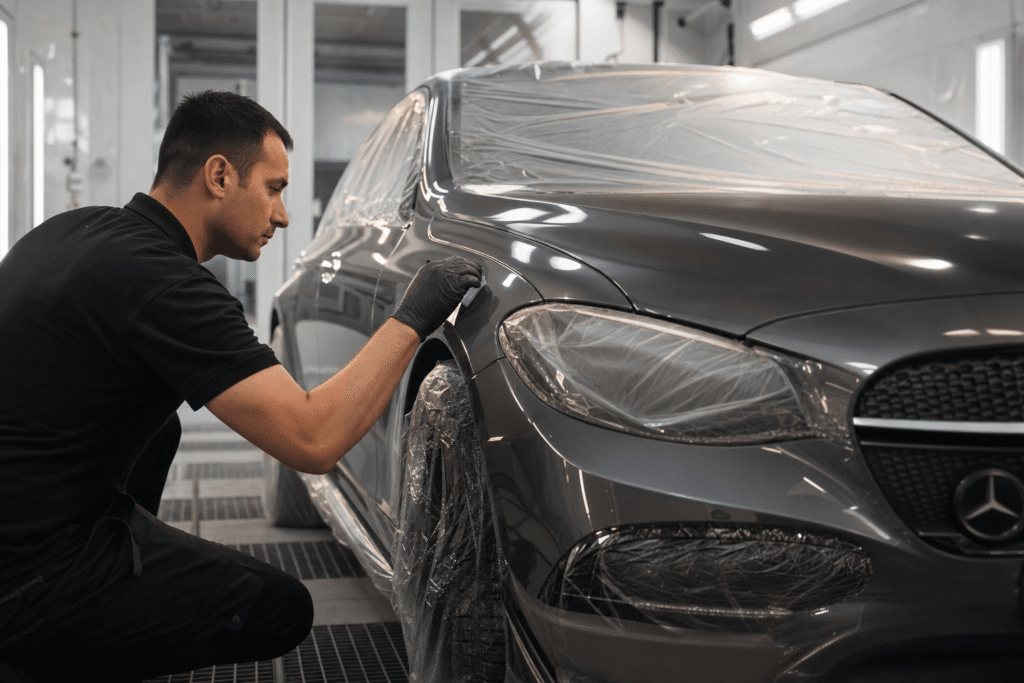
When you’re getting our professional collision repair services, understanding how long auto body paint takes to dry is critical to protecting your investment. The short answer: auto body paint reaches a touch-dry state in 1-2 hours, becomes safe to drive after 24 hours, and achieves full cure in 30-90 days. But these timelines vary dramatically based on paint type, environmental conditions, and application method.
This guide breaks down every stage of the auto body paint drying process, from the moment the clearcoat leaves the spray gun to the day your paint reaches maximum hardness. You’ll learn when it’s safe to drive, wash, and apply protective coatings, plus what factors speed up or slow down the curing process. We’ll also cover how North Vancouver’s coastal climate affects these timelines and what happens when you don’t wait long enough.
Whether you’re dealing with collision damage, deep scratches, or a full respray, knowing these timelines helps you avoid costly mistakes and ensures your paint job lasts for years.
Quick Answer
Auto body paint takes 1-2 hours to become touch-dry, 24 hours before safe driving, and 30-90 days to fully cure depending on paint type and environmental conditions. Waterborne systems cure faster in controlled environments, while humid coastal climates extend drying times significantly.
How Long Does Auto Body Paint Take to Dry? Understanding the Stages
Auto body paint doesn’t dry all at once. It moves through distinct stages, each with different characteristics and limitations. Understanding these stages helps you know what your car can handle at each point in the process.
Most car owners confuse “dry” with “cured.” They’re not the same thing. A paint surface can feel completely dry to the touch while still being vulnerable to chemical damage, water spots, and physical marring. The full curing process involves complex chemical reactions that continue long after the surface feels solid.
Touch-Dry Stage (1-2 Hours)
The touch-dry stage is exactly what it sounds like. The paint surface no longer transfers onto your finger when you lightly touch it. This happens when enough solvents have evaporated from the top layer to form a skin.
But don’t mistake this for full drying. The layers underneath are still soft and chemically active. At this stage, the paint can still be damaged by pressure, dust contamination, or premature handling. Professional shops like TDB Auto keep freshly painted vehicles in controlled environments well past the touch-dry stage to prevent surface defects.
Modern basecoat/clearcoat systems typically reach touch-dry in 30-60 minutes under ideal conditions. Single-stage paints take slightly longer, usually 1-2 hours. Temperature and humidity dramatically affect these times.
Handling-Dry Stage (24 Hours)
After 24 hours in a temperature-controlled environment, most automotive paints are hard enough for careful handling. You can drive the vehicle, close doors normally, and perform basic functions without risking damage to the paint surface.
This is when most body shops release vehicles to customers. The paint has achieved enough cross-linking that normal use won’t leave fingerprints, swirl marks, or soft spots. But it’s still not fully cured.
Full Cure Time (30-90 Days)
Full cure is when the paint reaches maximum hardness and chemical resistance. This process takes 30-90 days depending on paint chemistry, environmental conditions, and the number of layers applied.
During this period, the paint continues to off-gas solvents and complete chemical cross-linking. The surface gradually becomes harder, more scratch-resistant, and more resistant to chemical contamination. This is why professional detailers and ceramic coating installers wait at least 30 days before performing paint correction or applying coatings.
Waterborne paint systems cure faster than traditional solvent-based systems, often reaching full cure in 30-45 days. Older urethane systems can take 60-90 days to fully harden, especially in cool or humid conditions.
Key Takeaways
- Expect touch-dry paint in 1-2 hours, safe driving after 24 hours
- Wait 30-90 days for full cure before ceramic coating or correction
- Avoid washing painted surfaces for at least 14 days after painting
- Infrared curing cuts initial drying times by 50-70% in professional shops
- Humidity levels above 70% can double drying times significantly
The Critical Difference Between Drying and Curing
Most people use “drying” and “curing” interchangeably. They’re fundamentally different processes with different implications for your paint job.
Drying is a physical process. Solvents evaporate from the paint film, leaving behind solid material. This happens relatively quickly, especially with heat or air movement. When paint is dry, it feels solid to the touch and won’t smear.
Curing is a chemical process. The paint molecules cross-link and form permanent bonds, creating a hard, durable film. This takes far longer and continues well after the paint feels dry. Curing requires specific temperature ranges and can’t be rushed beyond certain limits without compromising the final result.
Here’s why this matters: dried paint can still be damaged in ways that fully cured paint resists. Chemical contamination, water spotting, marring from improper washing, and even UV damage affect uncured paint more severely than fully cured surfaces.
Drying Times for Different Types of Automotive Paint
Not all automotive paints are created equal. Different paint chemistries have dramatically different drying and curing characteristics. Understanding what type of paint was used on your vehicle helps you set realistic expectations.
Basecoat/Clearcoat Systems
Modern automotive refinishing almost exclusively uses basecoat/clearcoat systems. The colored basecoat provides color and coverage, while the clearcoat provides gloss, depth, and protection. Basecoat typically dries in 15-30 minutes between coats and reaches touch-dry in 30-60 minutes. Clearcoat reaches touch-dry in 1-2 hours under controlled conditions. It becomes handling-dry in 24 hours and reaches full cure in 30-60 days. Professional shops apply 2-3 coats of clearcoat, with 10-15 minute flash times between coats.
Waterborne vs. Solvent-Based Paints
Environmental regulations have pushed many regions toward waterborne paint systems. These paints use water as the primary carrier instead of organic solvents, reducing VOC emissions significantly. Waterborne basecoats require air movement to evaporate water effectively. In a properly equipped paint booth, waterborne basecoat dries in 20-40 minutes. Despite the water content, waterborne systems often cure faster than traditional paints, reaching full cure in 30-45 days compared to 60-90 days for older urethane systems.
Solvent-based paints flash off quickly and provide excellent flow and leveling. Full cure takes 60-90 days, but they’re more forgiving in less-than-ideal environmental conditions.
| Paint Type | Touch-Dry Time | Drive-Safe Time | Full Cure Time |
|---|---|---|---|
| Waterborne Basecoat/Clearcoat | 30-60 minutes | 24 hours | 30-45 days |
| Solvent-Based Basecoat/Clearcoat | 1-2 hours | 24 hours | 60-90 days |
| Single-Stage Paint | 2-3 hours | 24-48 hours | 60-90 days |
| Catalyzed Urethane | 1-2 hours | 24 hours | 45-60 days |
Single-Stage Paint Systems
Single-stage paints combine color and gloss in one product. They’re less common in modern collision repair but still used for fleet vehicles and some custom applications. These paints take longer to dry because they’re applied thicker. Touch-dry typically requires 2-3 hours, and full handling safety takes 48 hours instead of 24.
Need a free estimate in North Vancouver?
Nima and the TDB Auto team offer honest, expert auto body repairs for all makes including European and luxury vehicles. No pressure, no unnecessary claims.
What Factors Affect Auto Body Paint Drying Time?
Even the best paint products won’t cure properly in the wrong conditions. Multiple environmental and process factors dramatically affect how quickly paint dries and cures.
Environmental Conditions (Temperature and Humidity)
Temperature is the single most important factor in paint drying. Most automotive paints are formulated to cure optimally between 70-80 degrees Fahrenheit. Below 60 degrees, drying slows dramatically. Above 90 degrees, paint can skin over too quickly, trapping solvents underneath.
Professional paint booths maintain precise temperature control. TDB Auto’s booth holds 72 degrees consistently, ensuring predictable drying times regardless of outside weather. This is especially important in North Vancouver, where outside temperatures fluctuate significantly throughout the year.
Humidity affects waterborne paints more than solvent-based systems. High humidity (above 70%) can double drying times for waterborne basecoats because water evaporates much more slowly in saturated air. Solvent-based paints are less affected but still slow down in extremely humid conditions. The ideal relative humidity for paint application is 40-60%.
Paint Type and Number of Coats
Thicker paint films take longer to cure. Each additional coat of clearcoat extends the drying and curing time because solvents must migrate through more material to escape. Standard refinishing typically uses 2-3 coats of clearcoat. Show-quality work might use 4-5 coats for extra depth and durability. Each additional coat adds 20-30% to the total cure time.
How Modern Technology Has Changed Paint Drying Times
Twenty years ago, auto body shops relied on natural drying at room temperature. Paint needed 48-72 hours before vehicles were safe to drive, and full cure took 90-120 days. Modern paint booth technology and infrared curing have revolutionized these timelines.
Climate-controlled paint booths maintain precise temperature and humidity levels, reducing initial drying time by 30-40% compared to uncontrolled environments. Instead of waiting 36-48 hours for handling-safe paint, controlled booths deliver consistent 24-hour results.
Infrared curing technology represents the biggest advancement in paint drying. Infrared systems use wavelength-specific light to heat the paint film directly without overheating the substrate. This accelerates solvent evaporation and speeds chemical cross-linking. Paint that would normally take 24 hours to reach handling-dry can be ready in 4-6 hours with infrared curing.
At TDB Auto, infrared curing is standard for car paint touch-up services and panel repairs. It allows same-day turnaround on minor work while maintaining factory-quality results. The technology is particularly valuable for European and luxury vehicles where owners need their cars back quickly but won’t accept compromised quality.
However, infrared technology has limitations. It only speeds the initial drying phase by evaporating solvents faster. Full chemical cure still takes 30-90 days regardless of the drying method used. Infrared also requires careful calibration for different substrates. Aluminum and carbon fiber panels require different heat settings than steel. Overheating aluminum panels can cause permanent warping. At TDB Auto, we adjust infrared settings based on your vehicle’s specific construction materials.
Modern waterborne paint systems also contribute to faster overall curing. While they require more careful humidity control during application, their chemical formulation allows them to reach full cure in 30-45 days instead of the 60-90 days required by older solvent-based systems.
When Is It Safe to Drive Your Freshly Painted Car?
The standard answer is 24 hours after the final coat of clearcoat. But that’s under ideal conditions with proper paint booth curing. Several factors can extend this timeline.
After 24 hours in controlled conditions, the clearcoat has achieved enough hardness to resist fingerprints, dust embedding, and minor contact. The paint won’t smear or mark from normal handling. You can open doors, use the trunk, and drive normally without damaging the finish.
But “safe to drive” doesn’t mean fully cured. The paint is still chemically active and vulnerable to certain types of damage. Avoid these activities for at least 7-14 days after picking up your vehicle:
- Automatic car washes with brushes or harsh chemicals
- Waxing or applying any paint sealant products
- Parking under trees where sap or bird droppings might contact the paint
- Prolonged highway driving in heavy rain (water spotting risk)
- Aggressive cleaning or rubbing of the painted surface
For the first week, treat your freshly painted car like it has soft skin. Normal driving is fine. Light rain is fine. But avoid anything that puts chemicals or sustained moisture on the new paint.
If your vehicle was painted in humid conditions or during winter months, extend the drive-safe timeline to 48 hours. Cold, damp conditions slow curing significantly. Professional shops account for this, but if you picked up your car on a rainy day, give it extra time before exposing it to moisture.
Highway driving deserves special mention. At speeds above 60 mph, wind pressure, road debris, and environmental exposure increase dramatically. While normal city driving is safe after 24 hours, avoid extended highway trips for the first 48-72 hours. This gives the clearcoat additional hardening time to resist stone chips and contaminant embedding.
How Long Before You Can Wash Your Car After Painting
This is where most paint damage occurs. Washing too soon can permanently mar the finish, embed contaminants, or cause water spotting that’s nearly impossible to remove.
The absolute minimum wait time is 14 days. Better is 30 days for the first proper wash. During this period, the clearcoat is still off-gassing solvents and forming its final molecular structure. Introducing water, especially with cleaning chemicals, interferes with this process.
If your car gets dirty during the waiting period, use a damp microfiber cloth to gently remove dust or light contamination. Don’t rub. Don’t use any cleaning products. Don’t use pressure washers or high-volume water.
What to Avoid After Fresh Paint
After 14 days, you can perform a gentle hand wash using pH-neutral soap and soft wash mitts. Avoid these until at least 30 days:
- Automatic car washes (brushes can mar soft paint)
- High-pressure washers directly on fresh paint
- Clay bar treatment or paint decontamination
- Wax, sealant, or ceramic coating application
- Compound or polish (wait 60-90 days)
Water spotting is a particular concern in North Vancouver’s hard water areas. Fresh paint is more porous than fully cured paint. Minerals in water can penetrate the surface and etch into the clearcoat. If rain gets on your fresh paint, gently dry it with a clean microfiber towel. Don’t let it air dry and leave water spots.
When Can You Apply Protection?
For customers considering ceramic coating and paint protection services, Nima recommends waiting a full 60 days after painting. Quality ceramic coatings bond chemically with the clearcoat. If the clearcoat hasn’t fully cured, the coating won’t achieve proper adhesion and can fail prematurely.
Traditional wax can be applied after 30 days. Synthetic sealants should wait 45 days. Any paint correction work like compounding or polishing requires waiting the full 60-90 day cure period to avoid removing too much clearcoat or causing permanent damage to the still-soft surface.
Special Considerations for North Vancouver’s Coastal Climate
North Vancouver’s coastal environment creates unique challenges for auto body paint curing. High humidity, frequent rain, and moderate temperatures all affect drying times and long-term paint durability.
Coastal humidity regularly exceeds 70%, especially during fall and winter months. This slows solvent evaporation and extends both drying and curing times. Paint that would dry in 24 hours in Arizona might take 36-48 hours in North Vancouver during December.
Professional shops compensate with climate-controlled paint booths. TDB Auto’s booth maintains consistent temperature and humidity year-round, ensuring predictable results regardless of outside conditions. But once you drive your vehicle out of the shop, it’s exposed to the coastal environment.
The biggest coastal challenge is rain exposure during the cure period. North Vancouver gets significant rainfall from October through April. If your car is painted during this period, you face difficult choices about where to park it for the first two weeks.
Ideally, park freshly painted vehicles in a garage or covered area for at least 14 days. If that’s not possible, use a breathable car cover. Don’t use plastic tarps or non-breathable covers. These trap moisture and create worse conditions than leaving the car uncovered.
Salt air is another coastal consideration. Marine air contains salt particles that can contaminate fresh paint. Once the paint fully cures, it resists this contamination. But during the first 30 days, salt can embed in the still-porous clearcoat and cause long-term issues. If you live near the water, wash your car more frequently once it passes the 30-day mark, but minimize exposure during that first month.
Temperature fluctuations also affect coastal paint jobs. North Vancouver experiences moderate temperatures year-round, rarely dropping below freezing or exceeding 80 degrees. While this seems ideal, the lack of consistent warmth means paint cures more slowly than in warmer climates. Add 7-10 days to cure timelines for winter paint jobs compared to summer work.
What Happens When You Don’t Wait Long Enough
Rushing the process causes specific, predictable damage. Understanding what can go wrong helps you appreciate why following the timelines matters.
Washing Too Early Creates Permanent Damage
Washing too early is the most common mistake. Water and chemicals penetrate incompletely cured clearcoat, causing clouding, water spotting, or dull patches. This damage often doesn’t appear immediately. It shows up 2-3 months later when the paint should be reaching full gloss but instead looks hazy or uneven.
We’ve repaired multiple Mercedes and BMW vehicles at TDB Auto where owners took them through automatic car washes within the first week after painting. The brush marks and swirl patterns embedded permanently in the soft clearcoat. The only fix was wet-sanding and respraying the affected panels, costing thousands in additional repairs.
Premature Waxing Traps Solvents
Applying wax or sealant too early traps solvents under the coating. The paint can’t complete its off-gassing process. This causes soft spots, discoloration, or adhesion failure where the coating literally peels away from the paint in sheets. The same problem occurs with premature ceramic coating application, except ceramic coating failures are even more expensive to correct.
Driving Too Soon Causes Physical Damage
While 24 hours is generally safe for normal driving, pushing limits causes problems. Highway driving within the first 48 hours exposes soft paint to stone chips that penetrate deeper than they would in cured paint. Road debris embeds in the clearcoat rather than bouncing off. One customer ignored our 48-hour highway driving recommendation and ended up with 15 chips on the front bumper that required touch-up work.
UV and Chemical Damage to Uncured Paint
Parking in direct sun before the paint fully cures can cause die-back, where UV radiation degrades uncured paint chemistry. The clearcoat becomes brittle and develops micro-cracking within months instead of lasting years. This is particularly damaging to modern waterborne paints, which rely on complete curing for UV resistance.
Chemical contamination from bird droppings, tree sap, or road tar causes etching in uncured paint. Fully cured clearcoat resists these contaminants for hours or even days. Uncured clearcoat can be permanently etched in minutes. If contamination happens during the cure period, rinse it immediately with plain water and gently blot dry. Don’t scrub or use chemicals.
Physical Pressure Leaves Permanent Marks
Physical pressure causes marring and texture issues. Leaning on fresh paint, placing items on the hood or trunk, or even using a squeegee on windows can leave permanent impressions. The paint might feel hard, but it’s still plastic enough to deform under sustained pressure. These impressions can’t be buffed out without removing significant clearcoat material.
We see paint failure most often when owners wash their cars too early or apply wax before full cure. Wait at least 14 days before the first wash, and avoid automatic car washes for 30 days. The brushes and harsh chemicals can mar soft paint permanently.
Frequently Asked Questions
How long does auto body paint take to dry to the touch?
Auto body paint reaches touch-dry in 1-2 hours under controlled conditions. Waterborne basecoats dry in 30-60 minutes, while clearcoat takes 1-2 hours. Temperature, humidity, and paint type all affect this timeline.
What is the difference between paint drying and curing?
Drying is when solvents evaporate and paint feels solid to touch (1-2 hours). Curing is the chemical cross-linking process that hardens paint to maximum durability (30-90 days). Dried paint can still be damaged by chemicals, pressure, or improper washing.
When is it safe to drive my car after it has been painted?
It’s safe to drive your car 24 hours after painting in controlled conditions. The clearcoat has hardened enough to resist fingerprints and normal handling. Avoid automatic car washes, waxing, and aggressive cleaning for at least 14 days.
How soon can I wash my car after getting it painted?
Wait at least 14 days before washing your freshly painted car, with 30 days being ideal. During this period, clearcoat is still curing and vulnerable to water spotting and chemical damage. Use a damp microfiber cloth for light dust removal only.
How long should you wait between coats when painting a car?
Wait 10-15 minutes between clearcoat applications (flash time) to allow solvents to partially evaporate. Basecoat requires 15-30 minutes between coats depending on temperature and humidity. Applying coats too quickly traps solvents underneath.
Trust the Experts at TDB Auto for Professional Paint Work
Understanding paint drying timelines protects your investment and ensures your repair lasts for years. But following these timelines only matters if the paint was applied correctly in the first place. Nima and the team at TDB Auto combine factory-certified techniques, climate-controlled paint booths, and modern infrared curing technology to deliver consistent, durable results on every vehicle. Our 5.0 Google rating from over 1000 satisfied customers reflects our commitment to doing things right, not fast.
Whether you need collision repair, scratch removal, or custom paint work on your European or luxury vehicle, we provide honest assessments and transparent timelines from the start. Visit us at 1468 Columbia St in North Vancouver or get a free estimate to discuss your specific repair needs. We’ll walk you through the entire process, including exactly what to expect during the drying and curing period, so your paint job delivers factory-quality results that last.
